CASE STUDY

Designing a payment experience that helps both sides register, verify, and understand a transaction when internet access is unreliable.
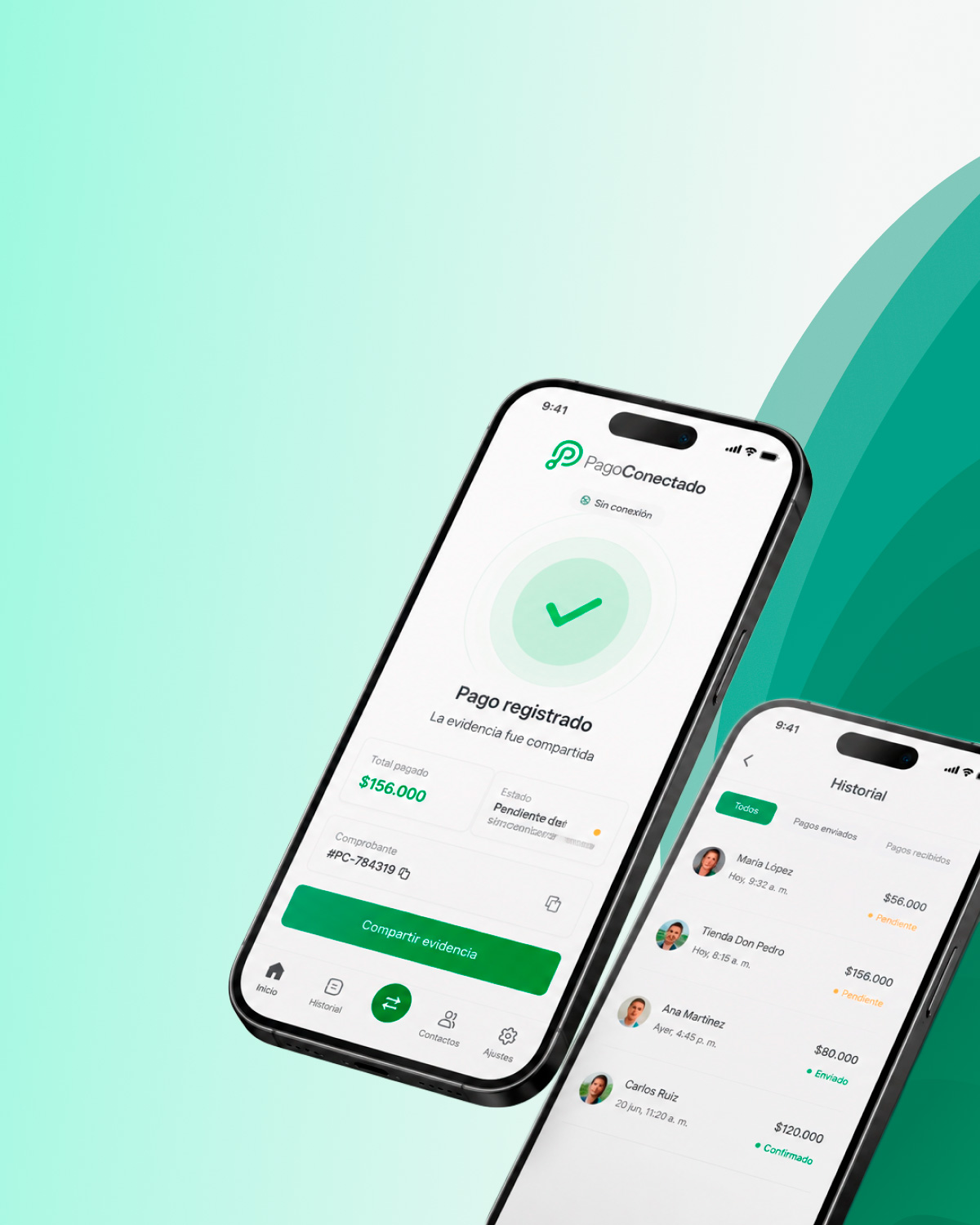
PROBLEM
The challenge
Digital payments usually assume stable connectivity. In rural stores and other low-signal contexts, that assumption breaks: a transaction can be initiated locally while confirmation, delivery, or synchronization remains uncertain. The design challenge was to preserve continuity without hiding what the system could and could not confirm.
- Connectivity could disappear during the payment.
- Sender and recipient needed the same evidence.
- Pending synchronization could lead to uncertainty or duplicate payment.
EVIDENCE
What the product definition revealed
Connectivity is not a binary moment
Evidence: The user journey could move between online, offline, and reconnecting conditions before the transaction was fully synchronized.
Impact: A generic loading or success message would not explain the actual state of the payment.
Confirmation must be shared
Evidence: Both parties needed to agree on the amount and recognize the same local transaction record.
Impact: One-sided feedback could create disputes or uncertainty at the point of sale.
Pending requires a clear next step
Evidence: A locally registered transaction could still be waiting for network synchronization.
Impact: Users needed to know what was complete, what remained pending, and whether they should act again.
DECISIONS
Design response
The interaction model separates local registration from network synchronization, while keeping both parties aligned through explicit states and shared evidence.
Connectivity may be lost before the network confirms the transaction.
Separate local registration from online synchronization and label each state explicitly.
Users can continue the exchange without mistaking a local record for a fully synchronized payment.
Sender and recipient need to recognize the same transaction.
Introduce a handshake before completion and provide mirrored evidence to both parties.
Both people agree on the amount, counterpart, and status before closing the sale.
Delayed synchronization can create doubt about whether to repeat the payment.
Persist the transaction in history and show pending, synchronized, or action-required status.
Users retain traceability and understand when the payment is complete without creating duplicates.


FINAL INTERACTION FLOW
INTERACTIVE PROTOTYPE
Try the critical flow
This functional prototype lets you explore PagoConectado’s key moment: recording a payment without connectivity, preserving evidence, and understanding what changes when the network returns.
- Start offline and select “Pagar”.
- Choose a recipient and amount; use the demo PIN
1234. - Return home, simulate connectivity, and synchronize the pending payments.
Simulated demonstration: it does not process money, request permissions, or store personal data. The product interface is presented in Spanish for its Colombian context.

Interactive mobile demo
VALUE
Outcome & learning
The prototype establishes a coherent interaction model for payments that may be registered locally before network reconciliation. Its value is not the promise of invisible offline processing, but the explicit communication of evidence, responsibility, and system status at every stage.
- Trust depends on understandable states, not only a final success screen.
- Shared evidence reduces ambiguity between sender and recipient.
- Offline-first design must explain what happened, what is pending, and what happens next.